

What We Build When Things Are Breaking: Practitioners on the Future of Equity-Centered Evaluation
/by Meghan Hunt (Engage R+D), Sonia Taddy-Sandino (Engage R+D), Michael Arnold (Informing Change), Pilar Mendoza (Engage R+D), and Evan Gattozzi (Informing Change)
Over the past decade, philanthropy has made significant strides in centering equity in learning and evaluation. Now, we face an inflection point that will determine the future of our field’s infrastructure. With support from the Robert Wood Johnson Foundation*, Engage R+D and Informing Change have been engaging funders and evaluation practitioners in conversations about how they’re navigating unprecedented challenges while preserving equity gains.
This blog post serves as a companion to a Fall 2025 funder field brief, Reimaging Learning and Evaluation, offering complementary reflections and insights from the perspective of evaluation practitioners. In addition to discussing threats to equity-centered learning and evaluation, we invited evaluators to share their collective wisdom and the collaborative power of the field to harness equity-centered transformations for the years to come.
Want to hear about future opportunities?
In December 2025, two dozen evaluation practitioners from across the country accepted the invitation, participating in one of two virtual sessions, to reflect on what funders shared and offer ways the field can work together to sustain and strengthen equity-centered evaluation. This blog post shares insights from those discussions, with ideas for how to build momentum and move the work forward.
The Current Landscape and Emerging Tensions: Practitioner Perspectives
Overall, practitioners echoed funders’ observations about threats to evaluation and learning, including fewer commissioned evaluations, cuts to federal research grants, and the downsizing or closure of evaluation firms. Practitioners also added that these changes can play out unevenly, with some firms remaining stable while others have sizably cut their workforce. Some have observed larger firms competing for smaller engagements they wouldn’t have pursued before, squeezing out smaller and BIPOC-owned firms. Others described pressure to drop equity language from their products and reports. Beyond the business pressures of sustaining small evaluation firms, practitioners named the emotional weight of this moment, including grief, anger, and painful stories from communities.
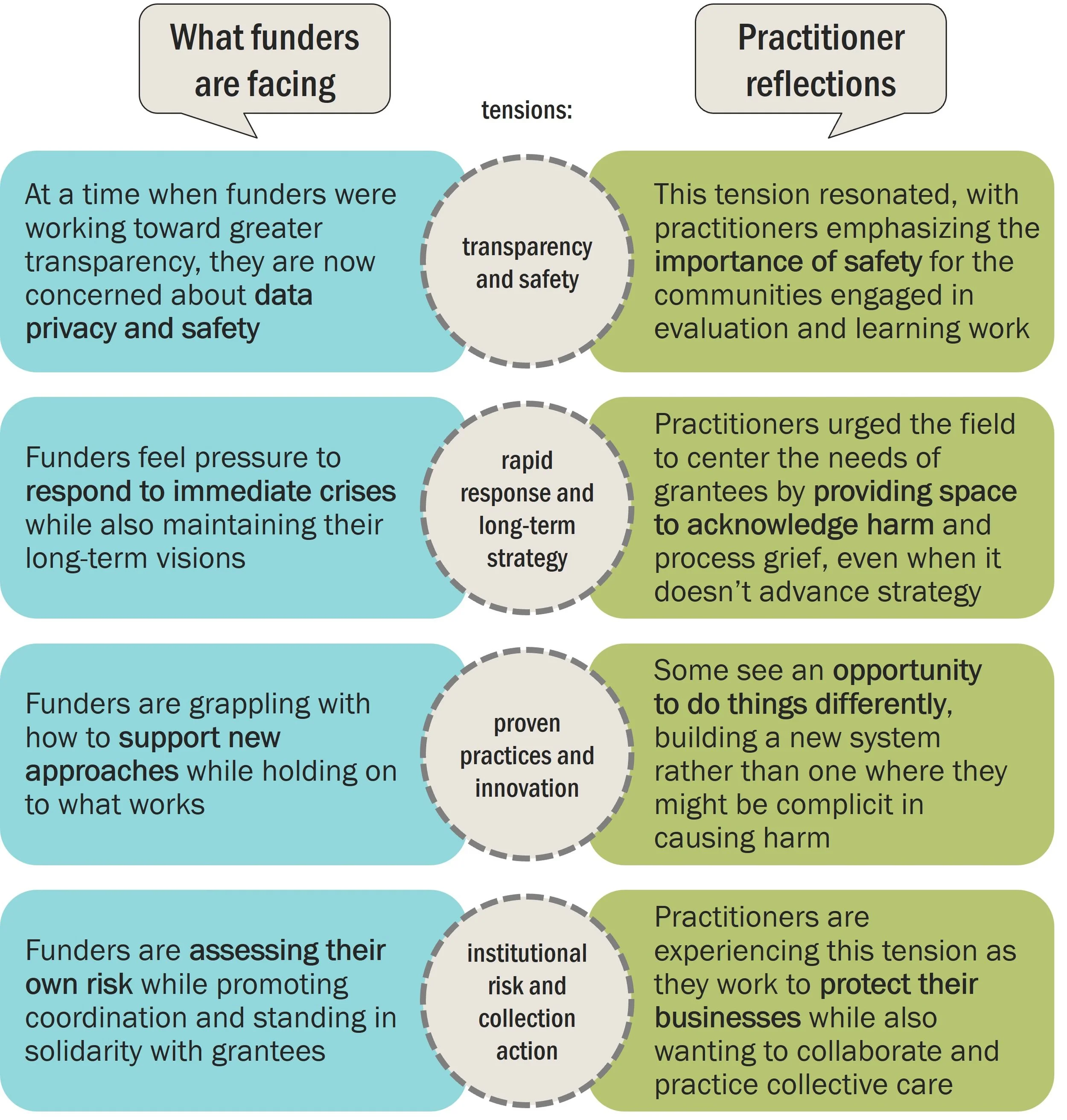
Navigating this context has created several tensions and trade-offs in the practice of equity-centered philanthropic evaluation and learning. From our conversations with funders, we described the four main tensions reproduced below. These resonated with evaluation practitioners, who added additional context and nuance from their perspectives:
Where We Go from Here
Our funder brief emphasized the strategic role that evaluation and learning can play in the current environment and called for building relationship-driven and equity-centered practices, preserving infrastructure through collaboration, and rethinking roles to design for the future. Practitioners built upon these ideas and, while there wasn’t a consensus on a single path forward, explored what this might look like in practice:
Make space for grief and healing as part of relationships and reflective spaces. Practitioners agreed that evaluation and learning practices should center relationships, and called for more spaces for grieving, dreaming, and restoration—both personal and collective. Some envisioned evaluation itself as a healing practice. When done in a participatory and inclusive way, evaluators can see and hear people in ways they might not otherwise be seen or heard.
Concrete support and ecological approaches can help preserve E&L infrastructure. Practitioners are acutely aware of the threats to equity-focused evaluation and learning infrastructure outlined in the funder brief. They called for more concrete support for small, solo, and community-based evaluators—including funding, networking opportunities, and small-business supports such as health insurance and shared back-office services. They also called for changes to contracting norms to favor BIPOC-led and smaller firms and strengthening regional evaluation ecosystems where community foundations can be champions. Others advocated for increasing evaluation budgets (some suggested 6% or more) or called for more transformative shifts away from hierarchical, competition-focused systems toward networked, collaboration-oriented ones. Indigenous ways of knowing can offer important frameworks for this type of ecological approach.
Funders have the power to rethink roles and design for the future. Practitioners want funders to use their positional power to take risks by standing up, speaking out, and creating cover for the nonprofit sector. As part of this work, funders can model and promote collaboration among practitioners rather than competition and lift up failures as important learning opportunities. In communities, funders can build grantee capacity for evaluation and learning, supporting communities in defining what success looks like and how it is measured. They called for simplifying bureaucratic processes that not only slow progress but also prevent change.
Integrate evaluation and learning with strategy. Throughout these conversations, practitioners returned to a fundamental point: if evaluation and learning are positioned as separate from strategy, they will remain vulnerable. The goal is for evaluative thinking to become how organizations create meaningful strategies and hold themselves accountable over time—not an add-on that can be cut when budgets tighten.
Many evaluation practitioners expressed a strong desire to move from talking to action - to experiment with collective models, share concrete actions and lessons learned, and connect to existing efforts across the ecosystem. Practitioners also emphasized that actions must be in service of a long-term vision and collaborative ethos that incorporates healing, abundance, and transformative change. Some of this work is already underway, and efforts such as the Equitable Evaluation Initiative, Expanding the Bench, and many others are working to strengthen collaboration and equity-centered evaluation across the field.
How do we help make change possible — especially under headwinds?
We find ourselves facing significant headwinds, but movement and power building efforts teach us that change often happens when progress feels microscopic and the odds aren’t in our favor. Transforming systems under pressure isn’t about big breakthroughs but the patient power-building, cultural groundwork, and the collective efforts of many who persist even when results aren’t immediately visible.
How can we be more intentional and accountable about the future we want to build? How can we connect, mobilize, and leverage various field efforts and partners to shift practice and cultural norms about who defines success, interprets data, and decides what happens next? What kinds of “small” equity-centered shifts in evaluation practice can function as field-building opportunities towards deeper transformation?
With this blog post and body of work, we hope to spark dialogue and action among field partners to answer and address these questions. Despite the headwinds, field partners continue forward to realize imagined futures. We hope our colleagues across the field will continue participating in this space as it evolves and as we elevate actionable ideas and wins both large and small. Watch this space for more to come!
*The views expressed in this post do not necessarily reflect the views of the Foundation.
