

Seeds in the Ground: What La Colmena is Teaching Us About Growing a New Economy
/Stories and lessons from Santa Ana’s first community-led land trust site — a cooperative hub built by and for the community
by Giannina Fehler-Cabral (Engage R+D), Ana Urzua (Cooperación Santa Ana), and Rubén Barreto (Community Hub of Santa Ana)
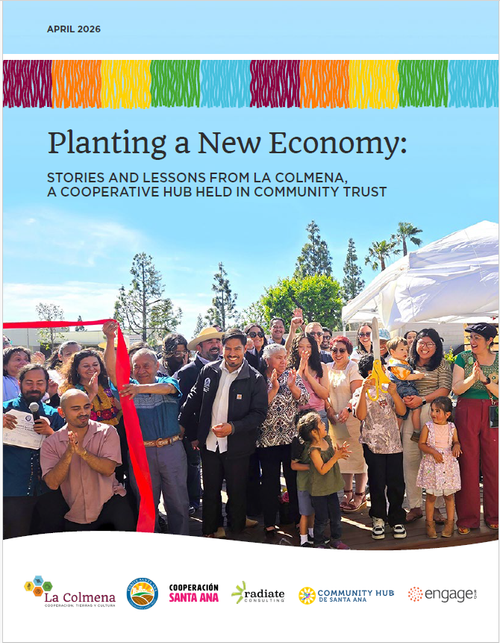
In the heart of Orange County, Santa Ana is a city of nearly 300,000 people — majority Latino, largely immigrant, working families who hold the local economy together while facing some of the highest cost burdens in the region. Those same residents have organized to shape their own future. In 2016, they stopped the sale of 90 parcels of public land. Through ongoing community organizing, they went on to found Santa Ana's first community land trust and earn community leaders a seat at the table in city decisions, building the foundation that eventually made La Colmena possible.
La Colmena (the hive) is a 16,000 square-foot site in Central Santa Ana where worker-owned businesses run on permanently affordable land, held in community trust, removed from the speculative real estate market, so it can never be sold out from under them. From nearly two decades of grassroots organizing to a 99-year lease win in 2020, a grand opening in April 2025, and the full purchase of the land in early 2026 — some seeds take years to bear fruit.
This post is written in the same spirit that made La Colmena possible: true partnership. Giannina Fehler-Cabral (evaluation consultant, Engage R+D), Rubén Barreto (community researcher and storyteller, Community Hub de Santa Ana), and Ana Urzua (Cooperación Santa Ana) came together around this story with support from the California Jobs First Initiative. Here we introduce our new report, Planting a New Economy: Stories and Lessons from La Colmena, a Cooperative Hub Held in Community Trust, and share what we learned about what it takes to build this new kind of economic model and why it matters now.
Why this moment matters
Communities like Santa Ana have long faced economic inequality, limited access to fresh food, and displacement pressure. This is not for lack of effort or talent, but because the systems around them were not built with them in mind. Nearly half of Latino households in Orange County cannot afford basic necessities despite being employed. Commercial rents in Central Santa Ana run $2,000–$3,000 a month — costs that make it nearly impossible for small, community-based businesses to survive. And decades of top-down development decisions have too often accelerated displacement rather than building community wealth. Worker cooperatives, businesses owned by its workers, where every worker-owner has a voice, a vote, and a share of the profits, and community land trusts, nonprofits that hold land permanently so it can never be sold off or priced out from under the people who depend on it, offer a different path. This model is rooted in ownership, not just employment. Research shows worker co-ops have an 80% five-year survival rate (vs. 41% for traditional businesses), and spending locally at a cooperative keeps three times more money in the community.
At the same time, as a generation of small business owners approaches retirement, thousands of businesses face closure with no clear succession plan. Cooperative conversion, where the current owner sells the business to its workers for shared ownership, is an underused solution that keeps those businesses — and the jobs and community relationships they anchor — alive and locally owned.
At a moment when federal support for communities is contracting and economic uncertainty is growing, models that keep ownership and decision-making local matter more than ever. Cooperatives aren't just about jobs. They're about autonomy, cultural continuity, and the kind of economic democracy that puts working families in the driver's seat.
What is La Colmena
La Colmena sits in the heart of Central Santa Ana — part urban farm, part gathering place, part incubator for community-owned businesses. Three businesses call it home:
La Milpa Café — a women-owned cooperative serving ethically sourced coffee and homemade desserts rooted in cultural tradition
SALSA Food Hub — an urban farm cooperative building local food sovereignty through a Community Supported Agriculture (CSA) program and agroecological farming practices
Duugich Art — a traditional small business preserving Oaxacan wool weaving traditions through the work of master artisan Don Gelacio Méndez
What makes La Colmena different isn't just what's sold there, it's how it's structured. Worker cooperatives put ownership in the hands of the people doing the work. Every worker-owner has a voice, a vote, and a share of the profits. Because the land is permanently protected by the community land trust, businesses can afford to stay rooted here for the long term. Together, these two models create something neither could build alone.
What the community told us
In fall 2025, we surveyed 92 Santa Ana residents who visited La Colmena — the majority Latino, mostly women, and mostly from Santa Ana itself. What they told us goes well beyond satisfaction with a product or service. Three themes came through clearly.
Belonging, connection, and culture. People described La Colmena as feeling like home — a place where they come con confianza, knowing they are welcome and truly belong. "Like family," one respondent said. "Like we are back in our homeland."
Economic justice and structural difference. Residents understood that La Colmena works differently. "La ganancia se queda aquí" — the profit stays here. "The community work comes first. La Colmena can offer space to groups and artisans in a way that a traditional business often cannot."
Well-being and hope. Participants used the word bienestar — complete wellbeing, for body, heart, and spirit. Beyond fresh, locally grown food, people described feeling hope: "When we take care of each other, everyone can thrive."
The numbers reflect it: 95% felt a sense of community when visiting. 92% believe La Colmena creates economic opportunities for the neighborhood. 96% had a satisfying experience.

What made it possible: Seven essential elements
La Colmena didn't come with a blueprint, so we asked the people who built it: what did it actually take?
Trust came up in every conversation — confianza as the foundation that makes everything else possible. So did the importance of listening, flexibility, and having partners willing to accompany the work over the long haul. And without exception, everyone named access to patient capital (i.e., capital rooted in long-term trust and relationships, not just dollars) as the difference between a project that survives and one that doesn't.
Seeds for other communities
La Colmena was built for Santa Ana. It’s rooted in its unique history, its people, and the relationships built over nearly two decades. But what it demonstrates belongs to a much wider conversation: that it is possible to combine a community land trust with worker cooperatives to create lasting, locally-owned economic infrastructure. The lessons in our report point in three directions:
For communities and organizations, relationships must come before anything else. The roots must go deep before anything can grow above ground. Trust, accompaniment, and a shared long-term vision are not soft elements — they are the infrastructure.
For cities and government, political will is essential. Planning, permitting, and funding structures will need to evolve. Community-driven timelines are not delays; they reflect the depth of engagement that makes this kind of development last.
For funders, patient, flexible capital is the difference between a project that survives and one that doesn't. Patience here means trust built over years, not annual cycles — funders willing to learn alongside communities, not just write checks against predetermined milestones.
Preview what we learned in our executive summary here: Planting a New Economy: Stories and Lessons from La Colmena
This work was made possible by the partnership and commitment of THRIVE Santa Ana, Cooperación Santa Ana, Radiate Consulting, Community Hub de Santa Ana and the worker-owners of La Milpa Café, SALSA Food Hub, and Duugich Art.
