

Rethinking Systems Change Under Current Conditions
/by Clare Nolan
What foundation learning leaders are seeing right now
Philanthropy is investing in systems change during a period of significant disruption across the social sector and in the communities it exists to serve. Policy shifts, funding disruptions, legal challenges, and attacks on equity-focused work have reshaped the operating environment for many nonprofits and foundations and intensified pressure on the people and communities most affected by those changes.
For many foundations, this volatility is putting new pressure on long-term strategies. It is also making visible where some of the assumptions that guide systems change work do not fully hold in practice.
Last month, I spent two days in Chicago with a group of evaluation and learning leaders from foundations committed to long-term systems change. The gathering brought together the second cohort of the Systems Change Community of Practice, which Engage R+D launched in 2023 as a place for foundation learning and evaluation leaders to work through some of the hardest questions in the field together.
During our time together, we explored how foundations are defining and bounding their systems change work; how leaders are using generative AI to support system sensing, reflection, and faster learning cycles; and what it takes to communicate effectively with boards and others who may be less familiar with this approach.
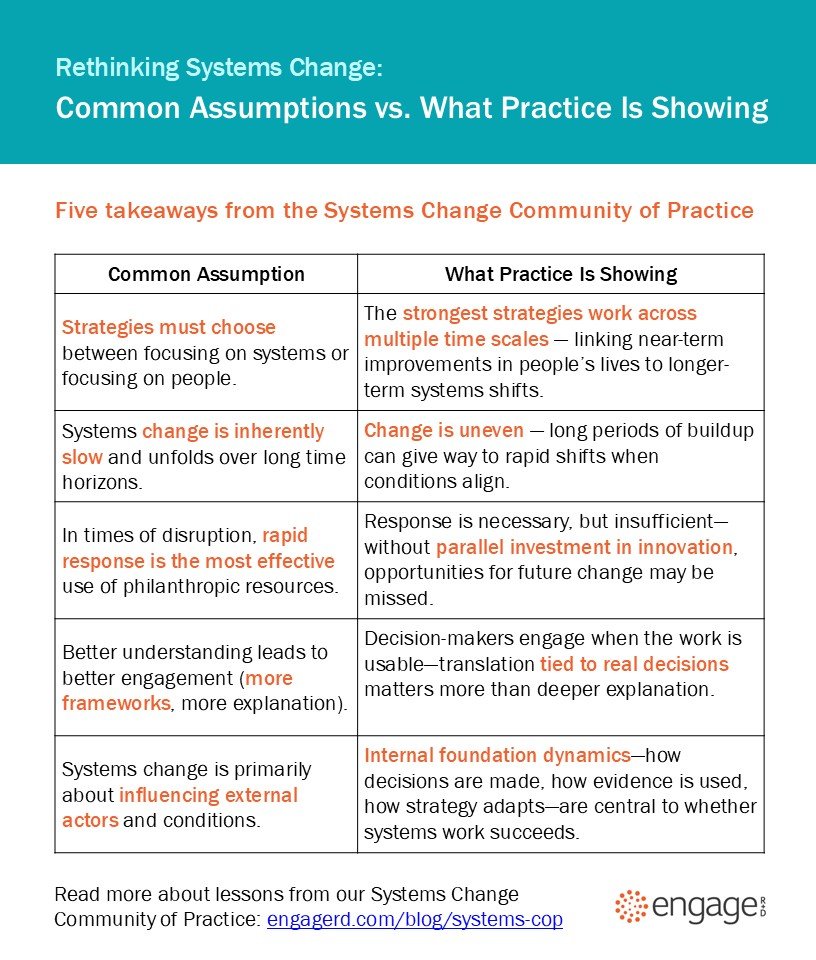
The conversations reinforced the importance of systems change while also raising questions about several assumptions that often shape how the work is understood and practiced. A one-page summary of the assumptions each one challenges is available to download at right.
Here are five takeaways that may be useful to others working in or exploring systems change.
1. Direct service without systems work rarely holds.
Systems change is a means, not an end. Foundations pursue it because real people, in real communities, need to be better off. And yet a common tension in philanthropy is the idea that strategies must choose between responding to immediate needs and focusing on long-term structural conditions.
Practice is showing that this is a false tradeoff. In times of crisis and rapid change, foundations need to stay close to what people are experiencing right now without losing sight of the conditions shaping those realities. The strongest strategies link near-term improvements in people’s lives to longer-term shifts in the systems that affect them.
Without that connection, systems work can become abstract and disconnected from lived realities. But funding direct service without attention to underlying conditions can leave funders responding to the same harms again and again. Durable progress requires working across multiple time scales.
2. Systems don’t always change slowly.
Philanthropy often talks about systems change as long-term work. That framing can be useful: it supports patience, persistence, and a willingness to invest beyond short grant cycles. But the past 18 months have been a reminder that systems can also shift quickly and dramatically.
The question is why some parts of a system can move so fast while others remain so hard to change. Policies, funding flows, and institutional priorities can shift quickly, especially when political or economic conditions change. Practices, relationships, behaviors, and mindsets usually move more slowly. Rapid shifts in who holds power and whose perspectives get centered can happen almost overnight; changing how people act, relate, and make decisions often takes sustained effort over time.
So the point is not that systems change is slow or fast. Change is uneven. Long periods of buildup can give way to rapid change when conditions align. Much of philanthropy’s work sits in that buildup phase, helping strengthen the relationships, capacities, narratives, and infrastructure that make more visible shifts possible later.
3. We need rapid innovation, not just rapid response.
For many people working in philanthropy, this period feels like a forest fire. Funding changes, policy shifts, and intensifying community needs are all moving at once. Even as people respond in one area, new pressures emerge somewhere else. The instinct is to focus on what is right in front of us: fight the fires, stabilize what we can, and preserve what matters.
Rapid response is necessary, but it’s not sufficient. Disruption can open space for systems innovation, and that window is easy to miss when all attention is on response. Several learning and evaluation leaders emphasized the importance of making room for forward-looking work even while managing crisis response.
If fighting fires helps preserve what was, planting seeds is how we shape what comes next. That means investing in the infrastructure and relationships that allow change agents to mobilize when openings emerge. It also means developing systems sensing as a practice: staying alert to when conditions are shifting so that unanticipated openings can be acted on intentionally rather than missed.
4. Explaining systems change isn’t always helpful.
There was a shared recognition that more systems change frameworks are not necessarily what people need, especially audiences who are not immersed in this work day to day. In some cases, more explanation creates more distance.
The assumption is often that better understanding leads to better engagement: if people just had the right framework, language, or explanation, they would come along. But in practice, decision-makers engage when systems change work is tied to the real decisions they have to make — about strategy, resources, risk, timelines, and accountability.
This often requires translation rather than explanation. It also requires repetition, reframing, and explicit attention to the mental models that shape how different people understand the work. The goal is not always to help people master systems change vocabulary. The goal is to make the work usable in the decisions that matter.
5. Foundations are systems too.
Foundations are part of the systems they are trying to change. This sounds obvious, but it is easy to lose sight of in practice. Systems change is often framed as work aimed at external actors and conditions. But internal foundation dynamics — who makes decisions, how evidence is used, what gets rewarded, whether strategy can adapt in real time — are central to whether systems work succeeds or stalls.
Building the internal culture, infrastructure, and patience to support ongoing learning does not happen automatically. It requires sustained, deliberate effort. Leaders named real constraints: siloed functions, expectations for short-term quantifiable results, and learning roles that are under-resourced or being absorbed into program work.
It is also important to remember that foundations rarely create change in isolation. They are one actor within a larger field that includes grantees, community members, governments, other funders, and many others. How well a foundation functions internally shapes how effectively it can play that relational role externally.
Recent work from Julia Coffman and Kecia Bertermann emphasizes testing assumptions and using evidence to inform strategic decisions in real time. In Strategy for Now, Jara Dean-Coffey reframes strategy as an ongoing practice of inquiry and adjustment in the face of complex and changing conditions, inviting organizations to build inquiry itself as a core organizational competence that keeps strategy alive and responsive over time. Taken together, this work points to a shift in how strategy and learning are understood: less as separate functions, and more as interdependent practices that need to operate in tandem.
Staying in the tension
These are not tidy conclusions. Systems change work requires navigating persistent tensions rather than resolving them neatly.
The Equitable Evaluation Framework™, for example, names tensions and sticking points that are often present in philanthropy. Many of those tensions were reflected in our conversations: resisting either/or framing in favor of both/and thinking; balancing urgent response with longer-term responsiveness; holding attention on individuals, organizations, and systems at the same time; and staying in practice even when conditions create pressure to revert to more reactive defaults.
Our Field Learning Agenda reflects areas where foundations are actively wrestling with tensions and questions, and where the field has the most to gain from learning together. We look forward to continuing to share insights from this work as it evolves.
What’s resonating for you? We’d love to hear what others are seeing from where they sit.
If you’d like to follow along with the Systems Change Community of Practice, you can sign up to stay connected here. If you’re a funder interested in joining a future cohort, please reach out to Clare Nolan.
